
Get a look at these frames, Clark Kent.

Warby Parker and the Social Framing of Community

How social good reshapes (and challenges) a digital-first industry.

Source: https://www.facebook.com/warbyparker

If you’ve ever bought prescription glasses, you know the drill: hella expensive frames, awkward and unflattering lighting, maybe a glazed over stare into the abyss while trying to select something that actually fits your face. Or if you’re like me and always pressed for time, grab the first thick black rimmed frames from the budget corner without actually looking, and end up with Kenneth Black eyeglasses for men (I’m a she/her female, and these are very masculine and not my thing).

Warby Parker looked at these type of experiences and said “we can do better.” In 2010, four Wharton classmates launched what would grow into a recognizable disruptor in retail.

They used social media as the frame of their business model. And I’m not intentionally being punny here. Social Media was the backbone to a bridge that made the concept of buying glasses online more exciting.

So, let’s look at how they did it, and how they’re doing it now.

Transformation of an Industry: Social Media over Showrooms

Warby Parker entered the market with a rad(ical) idea to design glasses in-house, sell them online, and skip traditional retail markups. This provided an opportunity to offer high quality frames at a more affordable price tag for their audience.

But disrupting a deeply ingrained purchasing habit can create dissonance. People weren’t sure they could trust buying something so personal as prescription eyewear online without being able to physically try on the frames. Afterall, this is outfitting the thing that we communicate with IRL. Our face.

Traditional advertising couldn’t fill the gap but social media could.

Facebook, Instagram, and Twitter (now X) allowed WP to communicate directly with their consumers, engaging with them on questions and sharing stories while allowing the brand to feel human and accessible.

Here, Clark. Try these on, would ya? You’ll be like… a whole new person.

Try ‘Em On: Social Proof Done Right

Warby Parker’s “Home Try-On Campaign” is still one of the smartest uses of UX + social in modern retail. Customers could order five pairs of WPs to try on at home, choose their favorite pair, and return the rest for free.

Functionally, it solved the try-on problem.
Emotionally, social media closed the gap.

WP encouraged customers to share photos wearing the frames and ask their friends for opinions. As you move through your network, low and behold, they become your styling team! According to the case study, those peeps who posted photos purchased twice the rate of those who didn’t! Social proof in action!

Early Transactions

Rather tan pushing one way advertising, WP pioneered a transactional communication method, opening the two-way door to dialogue with customers. They were able to:

  • Quickly respond to comments
  • Encourage user-generated content (UGC)
  • Create educational videos
  • Ask fans to share their own content

This built trust, because good ole WP was talking with their customers, not at them.

Negative Space: When the Convo Turns

The early successes of the case study are inspirational, but the modern reality is a bit more complex. While reviewing Warby Parker’s current Facebook and X presence, I noticed a very different tone from some customers.

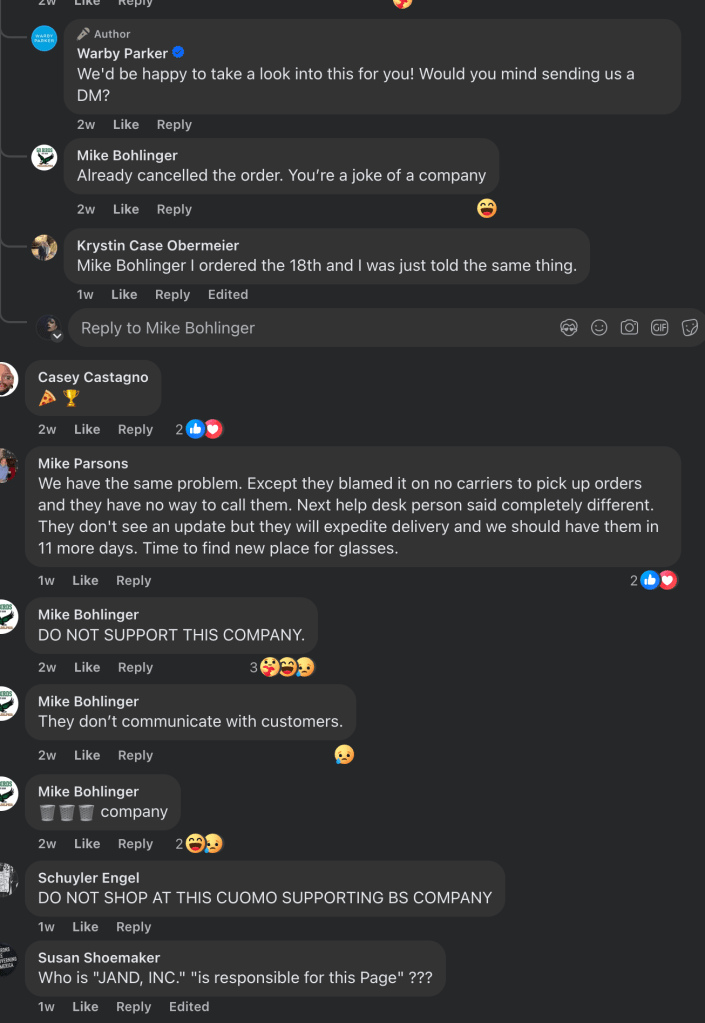
One commenter recently repeatedly pollutes “🗑️🗑️🗑️ company” across multiple posts.
Source: Facebook

Others shared frustrations about delays, inconsistent customer service responses, and a sense that WP “doesn’t communicate” with their customers.

Social media doesn’t just amplify positivity. It amplifies patterns, including negative ones. And when multiple customers echo the same concerns, it shapes the brand narrative just as powerfully as the early UGC once did.

This transactional communication needs be ongoing and not just foundational. WP built trust by engaging personally and consistently. But as the brand has scaled, maintaining that level of community care appear more challenging.

The End of the Home Try-On Program

One recent Facebook comment grabbed my attention as I was spiraling down the social media investigator rabbit hole. It directly contradicts the core success strategy from the case study:
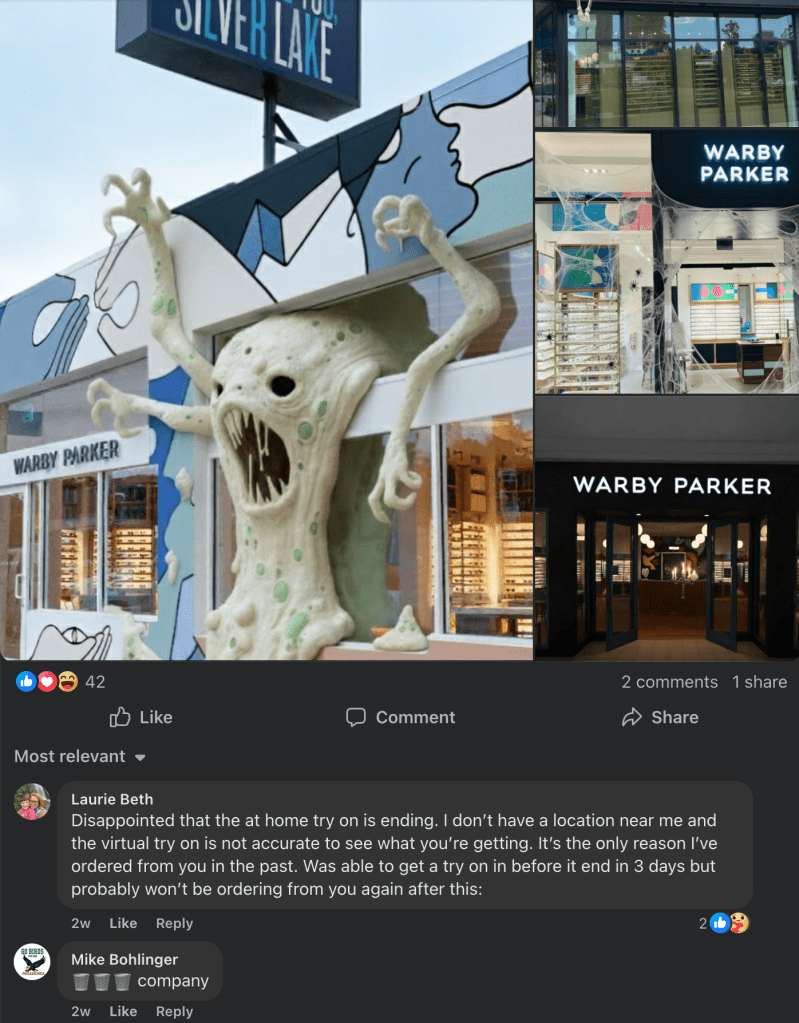
Source: Facebook. (Again, I know… Ugh Facebook. But, hey! There is our 🗑️ commenter again!)

This is significant. The Home Try-On Campaign was literally the mechanism that reduced that dissonance and encouraged UGC. Removing it takes away a foundational part of what made WP special.

I’d be bold as to say it also highlights a larger issue. Many virtual try-on tools still feel inaccurate or impersonal—even in my own experiences.

I recall my father parading around in one of his 20 pairs of Zenni Optical frames around the same time of WP’s Try-On launch. He could upload a photo of himself (I loathe the word “selfie”) and overlay frames to see how they would look. This was probably 10-15 years ago! More very recently, I ordered two pairs of frames from VooGlam for a total of just $66! Prescriptions included! AND I RECEIVED THEM IN 7 DAYS. Even their budget-friendly virtual try-on helped me feel comfy in my decisions.

So in a landscape where competitors offer:

  • Lower prices
  • Accurate virtual try-on tools
  • Faster delivery
  • Wider style ranges
  • No physical store requirement

… Warby Parker removing its most trusted, customer-loved feature raises logical concerns about the future of their differentiation strategy.

Innovation requires maintenance. What was groundbreaking in 2010 isn’t necessarily wowing folks as much in (almost) 2026.

Where’s the Tape to Fix This?

Despite these challenges, WP still offers meaningful lessons in dissonance reduction.

☑️ User-generated content builds trust
Seeing real people try on real frames remains a persuasive form of social proof.

☑️ Educational content solves uncertainty
Warby Parker’s friendly, approachable videos help simplify a process that can feel technical and overwhelming.

☑️ Purpose-driven branding creates emotional resonance
Their Buy-a-Pair-Give-a-Pair initiative with VisionSpring has provided over 20 million people with glasses, giving customers a story worth sharing and a reason to feel good about their purchase.

Even skeptical peeps like me are more willing to try something unfamiliar when it aligns with their feel-good values. WP’s success was about community, connection, social proof, transparency, convenience, and purpose.

So, where is that tape?

Today, their challenges show something just as valuable: Social-first brands must continuously evolve, because their communities are already evolving. Their journey from disrupter to powerhouse teaches marketers that social strategy is a living, shifting ecosystem shaped by its customers, competitors, and the brand’s willingness to keep listening.

Add to the conversation

Comments (

9

)

  1. ryleemullen

    Lauren, you raise some compelling points about how Warby Parker’s early social media driven strategy helped them build deep relationships with customers, and how the shift away from that might weaken their brand reputation especially after everyone fell in love with the at home try on system. Here’s how I see it: yes many of Warby Parker’s original strategies are highly applicable and instructive for building consumer relationships and brand loyalty, but I agree that their recent changes suggest a risk if they don’t adapt carefully.

    Their Home Try-On campaign was brilliant not just as a purchase tool, but as a mechanism for generating successful user generated content. Customers ordered five frames, tried them on at home, and shared photos on their social media asking friends for opinions. According to case study data, people who shared their try on pics purchased at twice the rate of those who didn’t (Maverick 2025). This created a sense of communal decision-making where your friends are your styling team, which significantly reduces purchase anxiety and builds trust. Rather than pushing one-way advertising, Warby Parker engaged in a transactional communication model which involved responding quickly to comments, encouraging questions, resharing customers’ content, producing educational videos and more. This was done to help humanize the brand and makes customers feel heard, not just sold to. Their Buy a pair, give a pair campaign offered purpose driven branding and corresponded with their social good mission deeply embedded in their brand (Maverick 2025). This kind of purpose resonates emotionally and customers feel their purchase contributes to something bigger, which fosters loyalty. According to their Impact Report, Warby Parker is working on reducing environmental impact as well which is something I never knew before diving deeper into this case study (Warby Parker 2025). This not only appeals to socially conscious consumers, but reinforces trust and alignment with customer values over time.
    As Warby Parker is transitioning toward a more omnichannel strategy by leaning more into in store experience and virtual try on technology, this shift suggests the company believes the physical interaction can sustain customer relationships that were once fostered by the at home try on program. If done right, this could maintain or strengthen loyalty by blending convenience with personal experience, but it is very risky after such positive feedback and results from their initial at home try on program. The Home Try-On was core to their early differentiation and social proof engine. For many loyal customers, this feels like removing what made Warby “special.” As you noted, some customers are already expressing frustration on social channels about this change. Based on recent customer commentary online, there are increasing complaints about delays, communication breakdowns, and outsourced customer service. For example: “They laid off a very big majority of the customer service team … expect to wait even longer for replies … Warby becomes a poorly run company” (Reddit 2025). Poor customer service can erode trust faster than anything. When a brand scales, maintaining authentic two way engagement is harder, but neglecting it threatens relationship equity that they worked so hard to build. I can totally understand why customers are upset with this transition. Warby Parker is pushing more into virtual try-on and while this is efficient, it’s a less tactile and emotionally rich experience than physically trying on glasses at home. For some customers, this may feel more transactional and less “community driven.” In my opinion, these recent negative feedback can be resolved if the company doubles down on the aspects that made them so successful to begin with. If they can find ways to continue to use social media to amplify stories from real customers who benefited from their purpose driven mission.
    They need to continue to encourage new ways for customers to share feedback, even if no longer via home try-on, perhaps through virtual try-on selfies or other interactive campaigns options. They need to invest in customer service and communication above all else and continue to make this a priority for their company. As the brand scales, preserving that one on one connection between the company and the client is critical. If customers are loudly complaining on Facebook, X, or Reddit, the company risks damaging long term loyalty.

    Within my own blog post, I mainly expressed the positives behind Warby Parker  but I truly admire how you were able to discuss both the positives and the negatives within your blog post. Warby Parker’s early social media based strategy offers us strong lessons about building relationships and brand loyalty: centering customers, enabling social proof, and aligning with purpose. But the company is at a transition point, and its long term loyalty depends on how well it maintains that community feel even as it pivots away from one of its original programs. If I were advising Warby Parker, I would recommend they not abandon the principles that built their community, even if the tactics seem to be evolving. Listening to customers, maintaining two-way communication and reinforcing shared values are timeless and Warby Parker should stay true to them. 

    I also just wanted to comment on how AMAZING your post looks! I am not sure if you have done these blogs or used WordPress in the past but you really seem like a pro. The way you were able to design your page and make it look so seamless with numerous important formatting and widgets to create a successful and effective blog post truly blew me away. I am so impressed and I truly enjoyed reading your blog post. It also made me giggle numerous times because you were able to incorporate a very casual and fun tone even while discussing an important and serious topic which I loved. Great job and I cannot wait to see what you come up with for the rest of this course! Looking forward to continuing to work with you. 

    Resources

    Dublino, Jennifer. “Best Business Blogs to Emulate.” Business.Com, 21 Sept. 2022, web.archive.org/web/20221002221751/https://www.business.com/articles/7-award-winning-company-blogs-to-emulate/. 

    Maverick, and Daniel Cruz. “10 Key Elements of the Warby Parker Marketing Strategy.” 10 Key Elements of the Warby Parker Marketing Strategy, 28 Mar. 2025, http://www.trymaverick.com/blog-posts/warby-parker-marketing-strategy-10-key-elements-that-built-a-7-billion-eyewear-brand?utm_source. 

    R/Warbyparker on Reddit: Stay Away from Warby Parker, 2025, http://www.reddit.com/r/WarbyParker/comments/1l0bz9u/stay_away_from_warby_parker/. 

    Warby Parker: Eyewear Online | We’ve Got Your Eyes Covered | Warby Parker, 2025, http://www.warbyparker.com. 

    Liked by 1 person

    1. Lauren Rae

      Heyyy Rylee!

      I had to dig for your comment, as I received a notification, but it actually was spam filtered! So glad I found it, because I truly appreciate how deeply you dug into my blog post. It’s an engaging response, and THANK YOU for choosing and taking the time to comment it, while also answering/reflecting on the question of long-term loyalty with the Home Try-On program ending. Well done!

      The Maverick (2025) stat really adds this, huh? Actually the whole article! 🧐 It basically confirms the findings about community validation. So if WP is migrating customers back into physical stores, they need to replicate that sense of community and co-creation in every new touchpoint. Although to see they are cutting out some customer service reps is a bit unsettling, but this could be par for the course in that a lot of retailers (both online and physical) are using AI to handle this portion of business models…

      Which is a whole other thing, and I promise not merry-go-round on it.

      Also, thank you so much for the kind words about my layout/design/writing. I’ve used WordPress for my former business, and am in it throughout my work week as I continually revise and update the company’s website. While I studied graphic design, webdesign is a bit of a different animal but the foundational points remain. I can’t code, however.

      Also looking forward to more from you! Thanks again for the engagement!!


      Lauren

      Reference

      Maverick, & Cruz, D. (2025, April). Warby Parker Marketing Strategy: 10 Key Elements That Built a $7+ Billion Eyewear Brand. Trymaverick.com. https://www.trymaverick.com/blog-posts/warby-parker-marketing-strategy-10-key-elements-that-built-a-7-billion-eyewear-brand

      Like

  2. karihopkins519

    Lauren, this analysis of Warby Parker is thorough, covering the evolution of its founding in 2010 to the landscape of the organization today, in 2025. From disrupting the traditional retail experience of purchasing eyeglasses and leveraging social media instead of traditional mass marketing, Warby Parker challenged people to move past their natural dissonance into a new realm of trying on and purchasing glasses. You captured this approach and personalized it, explaining how Warby Parker used social media sharing to fulfill the emotional gap of trying on glasses before purchasing. According to Mahoney and Tang (2017), social media is unique in its ability to enable real-life involvement in decision-making processes. Additionally, you pointed out that Warby Parker’s marketing strategy encouraged two-way dialogue with customers, which built trust and brand loyalty.

    The most interesting part of your blog was the exploration of Warby Parker’s journey after the case study was written. The glowing social media tone of the earlier days of the organization changed to posts expressing frustration and negative experiences, which was an unexpected twist. Covering all facets of the organization, along with tips to change the narrative, completes the full picture of Warby Parker.

    References

    Mahoney, L. M., & Tang, T. (2017). Strategic social media: From marketing to social change. Wiley-Blackwell.

    Liked by 1 person

    1. Lauren Rae

      Hi Kari!!

      Thank you so very much for choosing my blog to comment on! I was super surprised to see the comment from the Facebook user about the end of the Home Try-On program, and it really got that hamster spinning the wheel in my brainspace. Because I feel sometimes the content in our studies might be slightly dated (even if only by a few years), it’s necessary and important to see how things might have changed from a case study — especially when it comes to social media! It’s real-time and constantly evolving, and with it, the audience!

      Thanks again!


      Lauren

      Like

  3. corey.lawson2

    Lauren,

    This is a very thorough rendition of Warby Parker and their journey over the last 15 years from 2010 through 2025.  You covered their initial foundation and transcendent goals to their modern approach today.

    I love how you were also able to tie everything together by sharing your experiences in purchasing glasses from the expenses, finance piece all the way to the unflattering lighting, to the time factor that goes into choosing glasses.

    Personally, I used to wear eyeglasses for several years and I had the exact same feelings and how I wish I knew about Warby Parker then.

    According to Mahoney and Tang, social media is designed for users to engage in dialogue and participate with each other.”  I love how you tied this thought process and Warby Parker’s business model together to encourage social media feedback and interaction back with Warby Parker.  

    Overall I felt like you were able to cover Warby Parker’s strategy elements and maintaining relationships with consumers very well and the entire blog just flowed eloquently and seamlessly.

    Mahoney, L. M., & Tang, T. (2017). Strategic social media: From marketing to social change. Wiley-Blackwell

    Liked by 1 person

    1. Lauren Rae

      Heyyyy Corey!

      Thanks so much for choosing my blog to share your thoughts! The case study was interesting in itself, and it’s been fun to dig deeper into how WP was able to set an example of customer engagement through the use of social media. Admittedly, I had never hear of this brand prior, so I was going in blind. (YES, PUN INTENDED. 🤓) It really is a great example of shifting passive observers to active contributors through participatory communication, as we read about from Mahoney and Tang (2016).

      Thanks again!


      Lauren

      Reference

      Mahoney, L. M., & Tang, T. (2016). Strategic Social Media: From Marketing to Social Change. Wiley Global Research (STMS).

      Like

  4. Ciara Park

    Hi Lauren,

    I really enjoyed reading your blog post on Warby Parker. You discussed everything from their founding principles and transcendent objectives to their current methodology. I liked how you were able to connect everything by discussing your experiences with buying glasses, including the costs, the financial aspect, the unfavorable lighting, and the time commitment involved in selecting a pair. I personally have worn glasses for my entire life, and the glasses-buying process can really be so tedious. It seems like Warby Parker has perfected an easier process for the average customer. One thing I found interesting was how Warby Parker now has an app to try on glasses virtually. “To accurately depict how they would appear in real life, the frames will be placed onto your face and even move with you” (Warby Parker). I thought you did a great job covering Warby Parker’s strategy components and upholding customer relationships, and the article flowed smoothly!

    Warby Parker. (n.d.). How to buy prescription glasses online in 6 steps | warby parker. Warby Parker: Eyewear A-Z. https://www.warbyparker.com/learn/how-to-buy-glasses-online

    Liked by 1 person

  5. Ashley Young

    Greetings, penman!

    Alright, you won.  I audibly giggled about 3-4 times by the time I got to the second Superman reference, which made it unreasonably upset about how no one could tell Clark Kent was really Superman. Yes, I get it—glasses can really make a difference in someone’s appearance but never that much.  Ah, the joys of fictional reality. Makes me feel less bad about myself when I happen to lose my glasses on my face.

    Not to be a Debby Downer but I appreciated the Negative Space.  Not to say that I took enjoyment in the negativity but to say that it was a humbling experience.  Four students created a company from just a $2,500 investment and it added a whole new way for us to shop for glasses today (Mahoney & Tang, 2021).  That within itself is praiseworthy but like all companies, it is not without its faults and shortcomings, especially when it comes to social media. Not everyone is going to know, or even care, about the background of the company.  They want results and instant satisfaction, and at the first sign of inconvenience they can be ruthless, which you perfectly illustrated. Even more of a factor is that people are naturally more likely to post a bad review than a good one, which can hurt a company in the long run (Sonido, 2023).  Due to the psychological factors like loss aversion and stronger emotional response to negative experiences, it’s no wonder why they say, “misery loves company”.  If my day is ruined, I want to ruin yours as well.

    Despite this, those negative comments can be used as fodder for the company to improve and figure out what areas in their process they can improve on, whether its hiring more people to answer questions or concerns or finding a new delivery company to correct issues of missing or delayed orders. Warby Parker had an amazing idea but unless they can continue to show that their online option is more convenient than shopping in-store, then they’re encouraging their followers to go back to doing things the traditional way. However, regardless of Warby Parker having its own storefront options, people may still opt to shop with their competitors if they deem the company to not be as transparent and authentic as they claim to be.  No one likes an inconsistent company.  So, hopefully they can switch up the narrative and get the positivity flowing again to rebuild their reputation and grow their audience and brand loyalty.

    Excellent blog post.

    Reference

    Mahoney, L. M., & Tang, T. (2021). Strategic social media: From marketing to social change (2nd ed.). Wiley Blackwell.

    Sonido, J. (2025, August 11). Why people are more likely to leave a negative review. Thrive Internet Marketing Agency. https://thriveagency.com/news/why-people-are-more-likely-to-leave-a-negative-review-than-a-positive-review/

    Liked by 1 person

  6. andrewludwig25

    Hey Lauren,

    I really enjoyed reading your post! You offer a fresh look at Warby Parker through the lens of style and identity (especially the references to Clark Kent). I like how you show that by tapping into a cultural icon, Warby Parker doesn’t just sell eyewear — they give customers a way to express personality and nostalgia. The idea of “frames as identity” allows customers to feel a bit like Clark Kent, or channel a certain vibe, helping the brand become more than a commodity; it becomes part of how people perceive themselves. That kind of emotional or aspirational branding builds deeper connections, not just one-time transactions. And when a brand feels like it “gets you,” you’re more likely to stick with it and come back for more.

    Great post!

    Andrew Ludwig

    Liked by 1 person