
Header Image: WeChat illustrates how social media platforms can evolve from communication tools into everyday infrastructure.
WHAT WEIXIN (WECHAT) REVEALS ABOUT THE WESTERN GAP
Western discussions of social media success tend to fixate on engagement metrics, content formats, or advertising performance. The case of Weixen (WeChat), however, exposes a more fundamental distinction:
successful platforms are behavioral systems build around how people already live.
KNOWING THE AUDIENCE:
Beyond Demographics to dependency
Mahoney and Tang tell us that an analysis of the audience needs to extend beyond basic demographics to include cognitive load, self-efficacy, and habitual use patterns. This requires an alchemical equation of behavioral data + contextual observation + cultural insight. We’re not just tracking the clicks or follower counts.
WeChat, the Chinese social networking app, was able to pull in young, urban smartphone users and ask a more pragmatic question than most Western platforms.
Where does daily friction exist?
How can we remove it?
Between complex Chinese characters, app switching for basic tasks, and managing fragmented payment systems, a solution was needed to collapse the unnecessary effort of multitasking into a single, streamlined system. WeChat wanted less resistance and more repeated use.
In other words, self-efficacy. The platform trained its audience into routine behavior through reduced friction and repeated success.
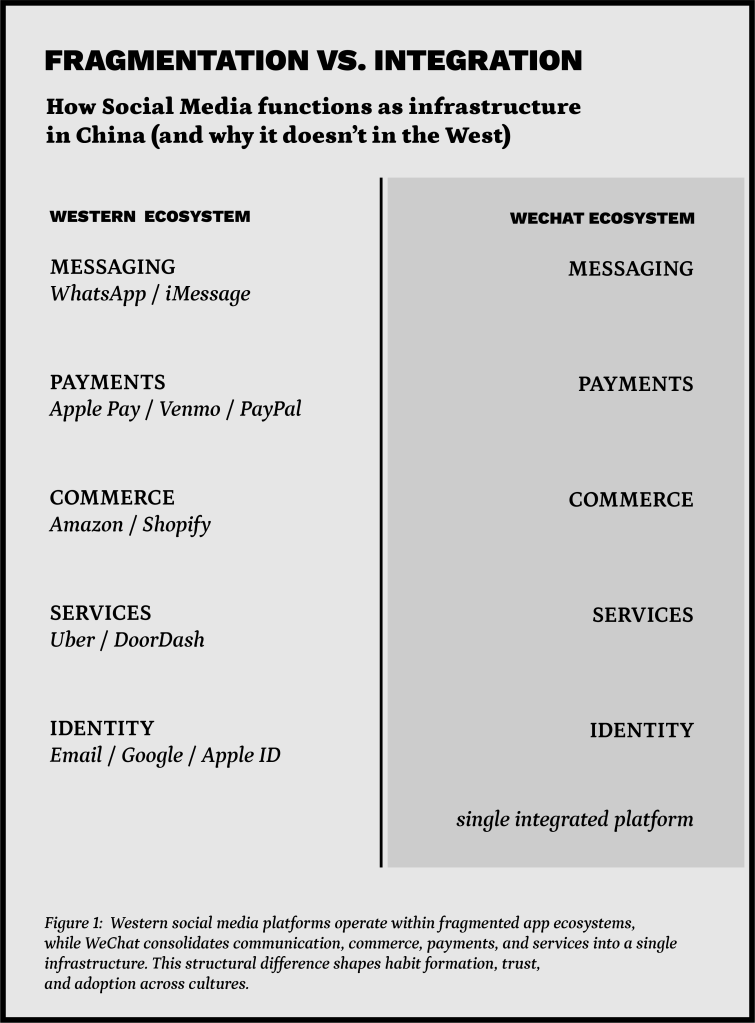
If the chart above shows how WeChat differs structurally from Western platforms, its individual features reveal how that structure is experienced behaviorally. Not as innovation, but as reduced effort repeated over time.
FEATURES THAT REFLECT BEHAVIOR (NOT INNOVATION)
WeChat’s features work because they’re working with how users already think and transact. Voice messaging reduces cognitive strain. In-app browsers eliminate unnecessary exits. Integrated payments negate the distance between communication and action.
Each feature reinforces the same behavioral logic: stay inside the ecosystem.
Campaigns like Red Envelope show this perfectly. WeChat digitized an existing cultural ritual and layered in suspense and social visibility. The result was a normalization of peer-to-peer digital payments. Nearly five million users participating, sending over 20 million virtual envelopes that reinforced habit and monetization pathways.
This is where Western platforms often misinterpret “personalization.”
While users can individualize feeds or settings, WeChat demonstrates that true customization occurs at the structural level, where platforms adapt to collective cultural behavior rather than forcing behavior to adapt to platform logic.
HABIT FORMATION
WHEN SOCIAL MEDIA BECOMES INFRASTRUCTURE
When usage requires effort or need for excess thinking, social media becomes powerfully habitual. WeChat embedded itself into everyday moments. Socializing, commuting, shopping, transportation.
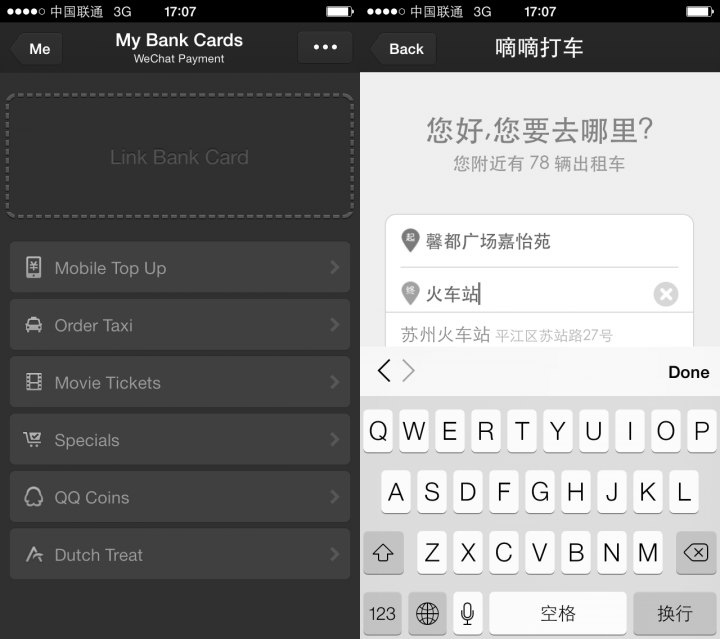
Didi Taxi trained users to complete IRL tasks within the app, which further ingrained trust and dependency. Over time, WeChat started to feel like an invisible yet tangible thing. An infrastructure always present, and yet rarely questioned.
This is all supported by scale data. By September 2025, WeChat surpassed 1.41 billion monthly active users globally, positioning it among some of the largest platforms in the world. Mini Programs alone reached 946 million active users in China by May 2025, reinforcing how deeply embedded the ecosystem has become.
WHY IT STRUGGLES IN WESTERN MARKETS
If it is sooooo effective, why are my friends, family, and peers not using it?
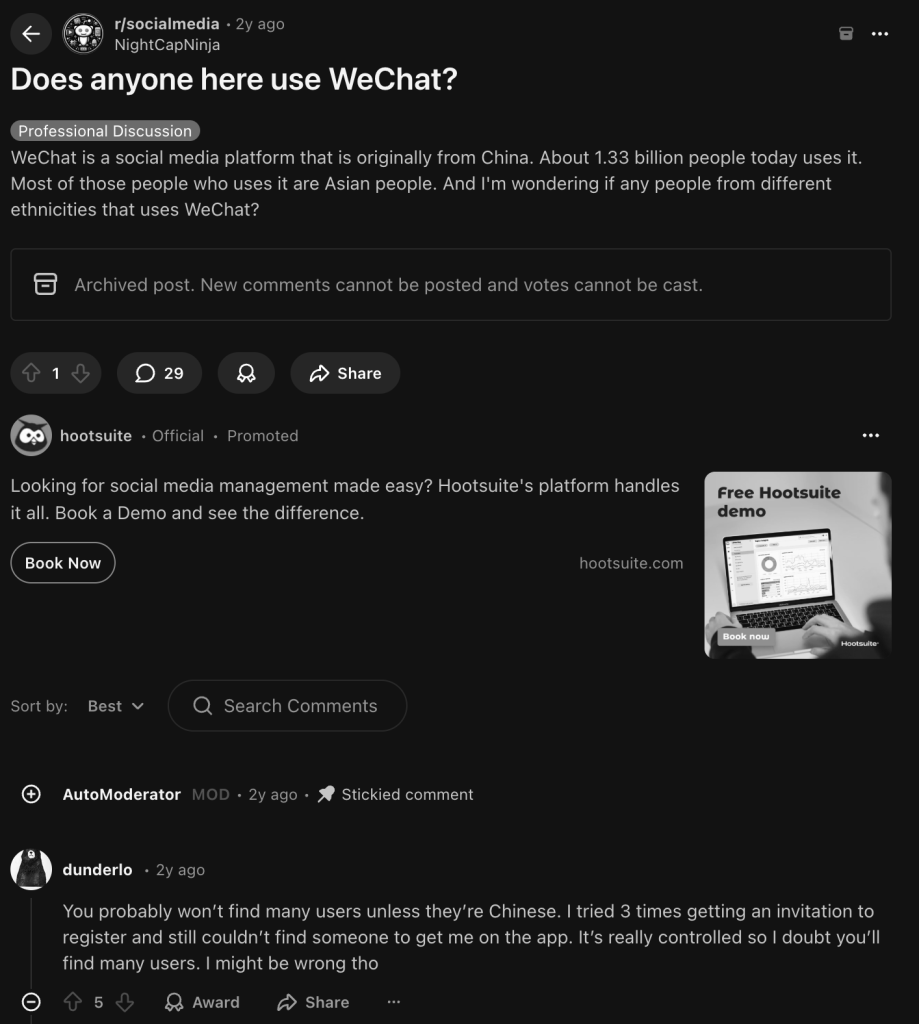
It’s not a lack of awareness. WeChat reached 39% adoption in 2024 here in the U.S., but…
usage was only at 4%.
It’s not a marketing failure. This is a structural mismatch.
Western audiences operate within fragmented ecosystems by default. We just love compartmentalizing our apps. It could be privacy preferences, scrutiny in regulations, or simple U.S. bullheadedness. WeChat succeeds in China, because Chinese audiences are culturally and infrastructural-ly prepared for consolidation.
You have to know your audience.
BUT
you also need to know what they won’t tolerate.
DeSIGNING FOR REALITY–Not REPLICATION
WeChat isn’t our blueprint or a copy + paste solution. It does however remind us that social strategy is about behavioral alignment. We don’t always need to chase novelty and engagement metrics.
Design your social media systems that fit the cultural context and daily routines.
….Or be left lost in translation.
 lauren rae
Add to the conversation