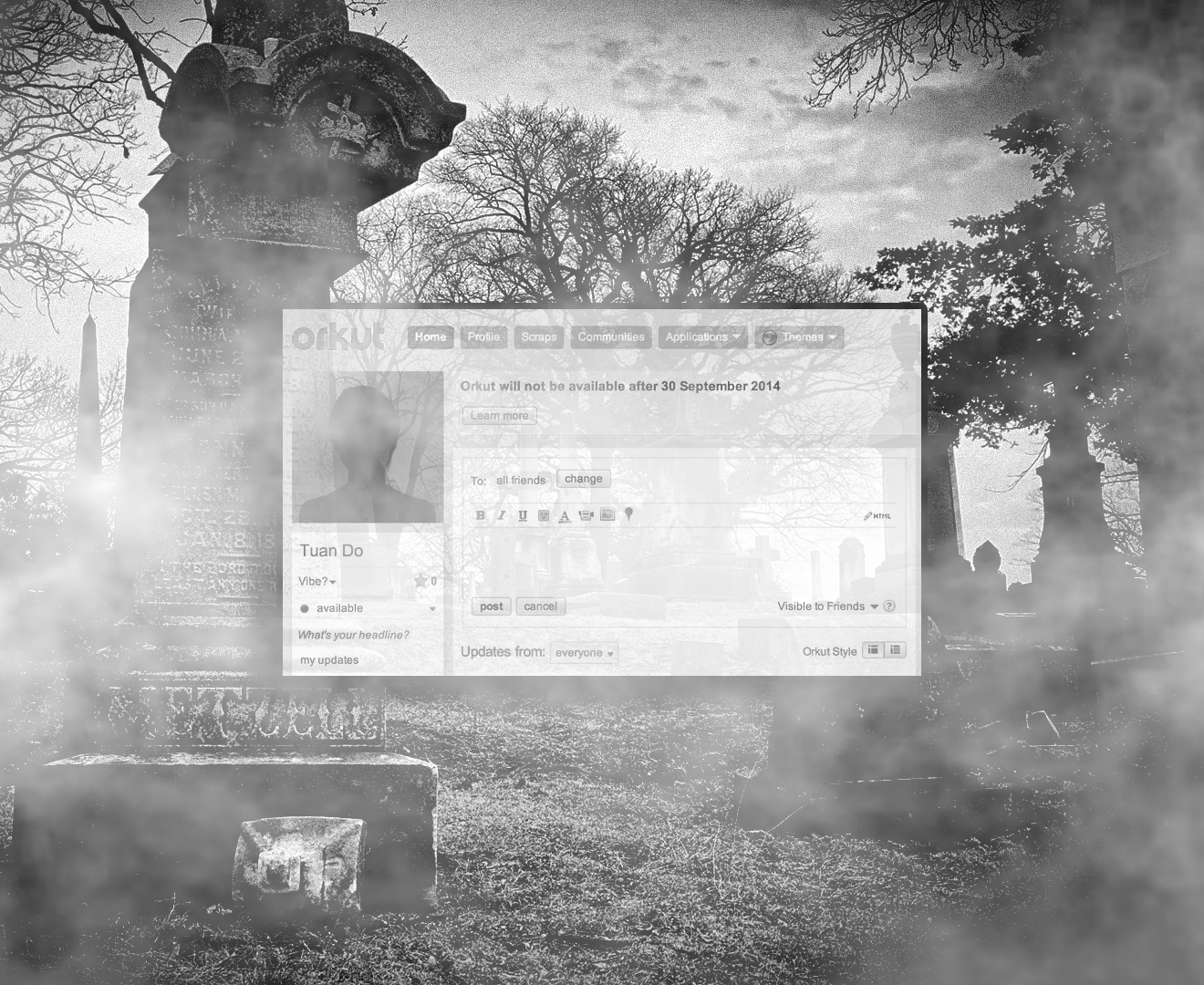
Header Image: TechWalls screen grab with some ghostly embellishments and a cemetery photo by yours truly.
“There’s enough for everyone to eat at this table.”
“Let’s show collaboration and unity among ourselves.”
“How can more people benefit?”
Back in the day before social media became about scale, monetization, endless (and mindless) scrolling, influencers… platforms like Orkut were already experimenting with the idea of connection over content. Some of the most meaningful communities I’ve been part of didn’t start with slick branding or some massive, viral reach.
They started with shared interests, trust, common goals, and spaces that made participation feel natural rather than performative.
Wait. What’s an orkut?
In 2004, Google and engineer Orkut Büyükkökten launched a new platform called simply “Orkut”. It was a social media platform structured around building communities that shared interests, allowing the users to discover each other through shared affiliations. Unfortunately, ten years later in September of 2014, Orkut shut down it’s platform.
During those ten years, however, it grew immensely popular in Brazil. Despite its shut down, a lot of lessons can be gleaned, from culture fit to community design.

Orkut as The Pendulum pushing community forward
What pushed the success of Orkut?
Community.
Is the theme blatantly obvious yet?
Orkut’s early success was driven by a thoughtful marketing action plan that emphasized exclusivity, trust, and the ease of participation. Its invite-only launch created a buzz-worthy level of prestige, amplified by Google’s growing brand reputation. When access was granted, users encountered a clean, intuitive interface designed to minimize friction and maximize discovery.
At the heart of Orkut were its communities. According to a case study, within four months, more than 50,000 communities had been created, eventually expanding to over 1.5 million within the first year. These spaces functioned as hubs for identity formation, peer connection, and recommendation. Users were able to signal both shared and individual interests and affiliations publicly. Rather than relying on top-down messaging, Orkut enabled value to be created between users, positioning community participation itself as the primary engagement driver.

Community Structure and the changing role of the digital consumer
Orkut emerged during a critical shift in the role of the digital consumer. Social networking sites were still fairly young upon its launch, but the digital consumer was changing from a passive recipient to an active participant. From consumer to user, they were shaping the social experience through community membership, peer ratings, and visible reputational signals. (Hey, you’re cool.) These mechanics introduced early forms of social gamification, thus reinforcing participation and visibility.
The participatory structure made Orkut fundamentally different from diffusion-based marketing models. Messages traveled through social proximity and trust. Not mass broadcast.
Those consumers-turned-users were more inclined to engage because they were interacting within environments that reflected shared interests and social meaning. They weren’t being targeted by impersonal brand messaging. Scholars like Mahoney and Tang have noted that digital platforms shape participation through the structures that enable people to act collectively. This was something that Orkut achieved early by centering interaction within communities rather than those broadcast feeds.
Okay, but why vibe and thrive mainly in brazil?
Well, dear reader. That’s a hella valid question. I’m so glad you asked!
Orkut’s most significant success was indeed within Brazil, where nearly 90% of its page views originated at the platform’s peak. An interview on NPR from 2010 highlighted the discourse of cell phone rate costs for most Brazilian users, drawing a connection to the digital community front of Brazil through the use of internet.
Orkut was a way to connect with friends and meet more, especially among teen users. Interestingly, outdoor advertising is a no-go in Brazil – banned nationally – which made online spaces an essential venue for both social interaction and brand discovery. Brazilian users demonstrated high trust in peer recommendations and frequently used social platforms as a research tool.
Orkut’s dominance in Brazil was not accidental. It aligned seamlessly with a highly social, teen-focused, and community oriented digital culture already primed for peer-driven interaction. A 2011 comScore also highlights the dominance of Orkut over Facebook, even as Facebook adoption began to increase.
Orkut aligned seamlessly with these cultural dynamics. Its community-based architecture mirrored how Brazilian users already communicated and formed relationships online. The platform turned from novelty network to social infrastructure. In this context, Orkut became embedded within the social communities of Brazil.

When the infrastructure failed the community.
Despite a strong foundation, Orkut struggled to keep up with evolving user expectations. Functional limitations like performance issues, friend count restrictions, difficulty sharing photos and video… all became increasingly visible as competing platforms expanded their features. In a market where users where growing more responsive to rich media and cross-platform engagement, Orkut’s slower evolution couldn’t keep up with the load times.
The decline wasn’t just because of Facebook’s rising popularity in the early 2010s. It came from a deeper misalignment. Orkut was no longer able to meet the needs of the culture it had nurtured. And when it could no longer support it, the once loyal followers migrated to platforms better equipped to sustain their communities.
A Legacy in Modern Community Platforms
Now, now. Just because it no longer exists doesn’t mean Orkut is not highly relevant.
Modern platforms like Reddit and Discord reflect many of the same community-first mechanics: those interest-based spaces, identity driven through participation, self governance, and trust are all built through contribution over follower counts. These platforms succeed because they invest in community health, moderation, and cultural continuity.
Orkut wasn’t “wrong.” It was early. Ahead of its operating time. Its legacy shows us the importance of maintaining and evolving the infrastructure that supports meaningful social interaction.

Hey L-Rae, Can you apply this iRL?
Hell yeah, I can!
These dynamics of community are visible beyond large-scale platforms. A little thing I’m starting on currently is similar to the lessons learned here. Pennsylvania Association of Merchants and Entrepreneurs (P.A.M.E.) will be a collaborative network of independent merchants and entrepreneurs. The collective will be built around shared visibility, cross-promotion, and mutual support.
Like Orkut’s early communities, value within P.A.M.E. will be generated through participation rather than promotion. Members strengthen the network by contributing, collaborating, and showing up for one another. It’s a way to demonstrate how a community-first infrastructure can remain powerful whether applied globally or locally.
Ask not what your social platform can do for you.
ask what you can do for your social platform.
What a Modern Orkut Could Do Today
So.
If Orkut were to relaunch within the next month of early 2026, its strategy should reflect the community focused successes of modern platforms. But, it should still address the gaps that led to its initial decline. Let’s look at some priorities:
- Design multimedia ready, interest-based communities that support both asynchronous discussion, and real-time interaction
- Empower community leaders with moderation and analytic tools to protect trust and culture
- Reinforce identity through participation and contribution quality rather than vanity metrics
Success would be measured by:
- Active participation within communities
- Retention and longevity of core groups
- Cross-community engagement
- User sentiment and trust indicators
The key here is that a modern Orkut would compete on belonging.
Not scale.
Sustainable social platforms are built by enabling people to connect meaningfully with one another.

Thank you for sharing digital space with me. Subscribe, tap a star, or add to the conversation below.
— Lauren Rae
Leave a Reply